

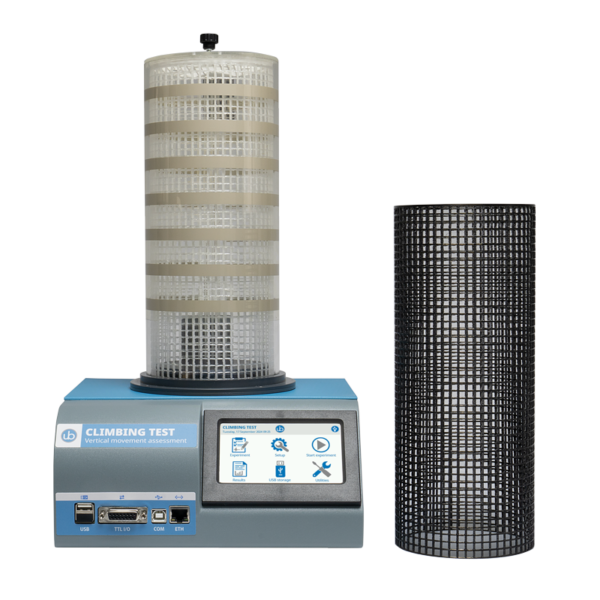


Climbing Test – Measures Vertical Activity in Rodents
MANUFACTURER – UGO BASILE
PRODUCT CODE – 36103
- Description
- Size Guide
- Specification
- Documents
Description
Climbing Test – Measures Vertical Activity in Rodents
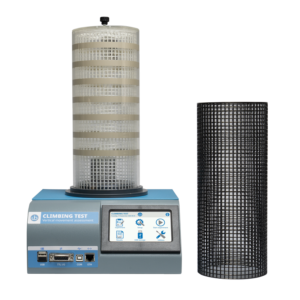
Description Of Climbing Test – Measures Vertical Activity in Rodents
Background
The device, developed in collaboration with the laboratory of Prof. Sidney Negus from Virginia Commonwealth University, provides a measurement of the vertical movement of rodents, a parameter which has not been widely investigated so far, in spite of the fact that rodents are animals that live in a 3D space and hence the analysis of XY position only is a limitation in many current studies.
However, climbing behavior and vertical movements have been previously studied in non-automated experiments to investigate many fields, from muscle strength (Ueno et al. 2022), to antidepressants (Perona et al. 2008), stroke (Jin et al., 2017), Parkinson’s (Sundstrom et al., 1990), sex-differences (Borbelyova et al., 2019), locomotor activity and kinematics (Green et al., 2012), neuroleptics and dopamine agonists (Costall et al., 1982; Pinsky et al., 1988; Medvedev et al., 2013), XYZ activity (Wexler et al. 2018), opioid receptors (Michael-Titus et al., 1989), neuropathic and cancer pain (Falk et al., 2017).
The Ugo Basile Climbing System aims to provide a simple and automated tool to measure vertical climbing movements within a grid cylinder to inform all the scientists that are interested in this crucial parameter for their research.
Climbing Test System Components
A load cell underneath the aluminum base (diameter 12 cm) provides the automated start of the test once the animal leaves the base and starts climbing over the cylinder (height 25.5 cm) and its ceiling, thanks to the 5x5mm internal grid.
The output parameters, stored in the electronic unit and exportable in Excel, include the %climbing, the number and duration of climbing episodes, the climbing time, the maximum and average climbing height and the total activity while climbing.
| Features | Benefits |
|---|---|
| Conductive sensors to track Z movements | Automated measurement of time climbing, distance travelled, time on ceiling, climbing episodes |
| Load cell floor | Automated start of the test |
| Electronic unit | Controlled by touch screen and with internal memory |
| USB and LAN data saving | Easy export into excel and data security |
| General | |
|---|---|
| Commands | 4,3 inches touch-screen (Resistive) |
| Read-out | 4,3 inches touch-screen (Resistive), PC |
| Power Requirement | Universal input 100-240 VAC, 50-60Hz, 200W MAX |
| Sound Level | Negligible |
| Operating Temperature | 18°C to 25°C |
| Endpoints and statistics: | Max height, Average height, Average distance covered, Total climbing time, Total time on roof, Latency on the single climbing event |
|
Operation |
|
| Start/Stop | By Start/Stop button on the climbing cage |
| Tare | By Tare button on the climbing cage |
| Experiment duration | Max 3600 seconds |
| Height sensors | 7 rings + 1 on the roof (capacitive sensors) |
| Data Acquisition | Via X-PAD software (included) |
| Data Portability | By USB flash drive (included) or LAN connection |
| Data Output | Results table in .csv |
|
Physical |
|
| Sensing cylinder diameter | External diameter 12 cm. Internal Diameter 11,5 cm |
| Grid cylinder diameter | 11 cm |
| Sensing cylinder height | 29 cm |
| Grid cylinder height | 28 cm |
| Weight | 5Kg |
| Shipping Weight | 8Kg |
| Packing Dimensions | 36x55x45cm |
|
Warranty |
|
| Warranty | 36103 is covered by a 12-months warranty + 12 months after product registration |


